The letters every plan writes policy against
The California Department of Health Care Services (DHCS) directs Medi-Cal managed care plans through All Plan Letters (APLs), numbered by year and sequence, such as APL 22-012. When DHCS revises a requirement it issues a new letter and states in the title which letter it supersedes. Plans then revise the policies that implement it.
The 17 member plans of the Local Health Plans of California (LHPC) publish their policies on public websites. We collected those documents into a policy knowledge base, extracted every APL reference from their text, and joined each reference to DHCS’s own supersession chain. The result is a citation graph: 1,983 plan documents, 315 letters referenced in them, and 2,525 places where a plan policy cites a letter.
Reading that graph gives a simple measure of how current a policy collection is: what share of its APL citations point to a letter DHCS has since replaced.
One in four citations, and no mention of the replacement
Across all plans, 2,525 citations reference an APL. 937 of them, 37%, cite a letter that DHCS has superseded.
Some of those are lineage references: a policy that names both APL 17-006 and its replacement, APL 21-011, is tracking the requirement’s history, not missing an update. Removing every citation whose document also cites a later letter in the same chain leaves 654 citations, 26% of the total, that name a replaced letter and nothing that came after it.
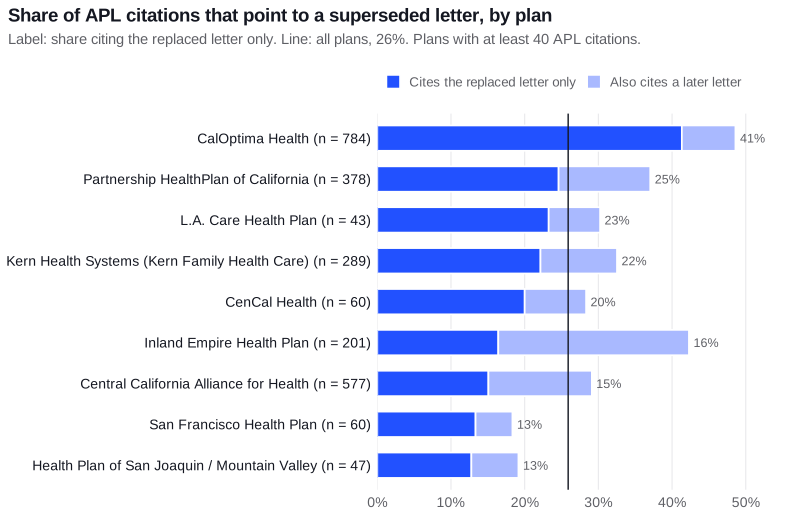
The range across plans is wide. At CalOptima Health, the largest corpus in the collection, 41 percent of APL citations name a replaced letter and nothing later. At Central California Alliance for Health, 15 percent do, and a further 14 percent sit in documents that also cite the newer letter. Five plans with fewer than 40 citations are omitted from the chart and shown in the table below; their rates are not reliable at that size.
WHAT THE NUMBER IS
A citation to a replaced letter is a flag for review. It is not evidence that the policy’s substance is out of date, and this brief does not assess substance.
One letter accounts for a fifth of the problem
The stale citations are concentrated. The most-cited replaced letter is APL 22-012, which implemented the Governor’s executive order moving Medi-Cal pharmacy benefits from managed care plans to the state’s Medi-Cal Rx program. DHCS superseded it with APL 25-013. It is still cited 142 times across eight plans, 136 of them without the replacement, more than the next three letters combined.
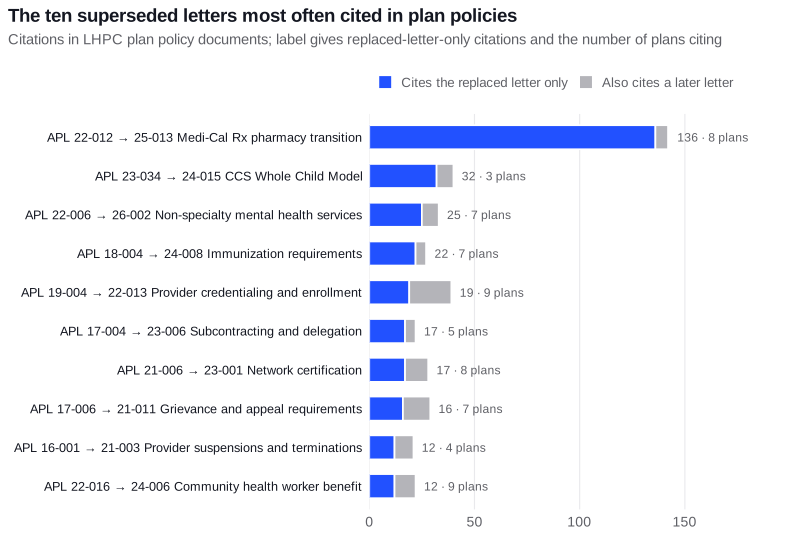
The rest of the list is the core of Medi-Cal managed care administration: provider credentialing, grievances and appeals, network certification, immunizations, delegation, and provider suspensions. All ten were replaced between 2021 and 2026.
Why the backlog accumulates
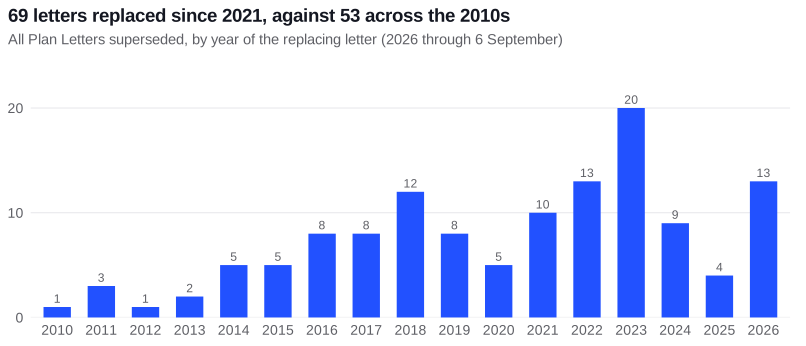
DHCS has replaced letters at a faster pace in recent years. Counting supersession events by the year of the replacing letter, the department retired 69 letters from 2021 through the first eight months of 2026, including 20 in 2023 alone, against 53 across the whole of the 2010s. Each replacement obliges every plan to find and revise the policies that cite the old letter, across 17 plans and collections of several hundred documents each.
What this brief does and does not show
- Descriptive, from a public-document corpus. The unit is a citation found in the text of a published policy. Nothing here evaluates whether a policy’s substance matches current DHCS requirements.
- A flag, not a finding. A policy can cite a replaced letter deliberately, as history or because the replacement did not change the cited provision. The old-letter-only measure removes documents that also cite a later letter in the chain, but it cannot read intent.
- Coverage is uneven. The corpus holds what each plan posts publicly and what our collectors could reach on 6 September 2026. CalOptima, Partnership, and Central California Alliance contribute more than 400 documents each and Kern 235; Contra Costa Health Plan, CalViva Health, Santa Clara Family Health Plan, and Health Plan of San Mateo contribute 10 or fewer; and three plans (Contra Costa, CalViva, and Community Health Group) have no citing documents at all. A plan’s rate describes its collected documents, not its full policy library.
- Extraction is automated. APL references are mined from document text with a pattern matcher; supersession is read from DHCS’s own letter titles. Both can miss cases: a letter replaced without a “supersedes” note in the title is counted as current, and a citation written in an unusual form is not counted.
- Point in time. Plans revise continuously. Two letters in the top ten, APL 26-001 and 26-002, replaced their predecessors in 2026, and plans may still be inside their revision window.
Data and sources
The plan policy documents were collected from each plan’s public website; the DHCS All Plan Letters and their supersession statements from the DHCS APL library. Both were indexed into the Causalytics LHPC policy knowledge base on 6 September 2026 and modelled as a graph of plans, documents, letters, implements edges mined from document text, and supersedes edges read from DHCS titles.
The extracted tables are published as CSV: APL citations by plan, most-cited replaced letters, and replacements by year. The charts are drawn from those files when this page is rendered. The export script that produces them from the graph is scripts/export_apl_currency.py in the knowledge base repository.
APL citations by plan, all 14 plans with citing documents (table)
| Plan | Documents | Citing documents | APL citations | To replaced letter | Replaced letter only | Share, replaced only |
|---|---|---|---|---|---|---|
| CalOptima Health | 462 | 175 | 784 | 381 | 324 | 41% |
| Central California Alliance for Health | 428 | 166 | 577 | 168 | 87 | 15% |
| Partnership HealthPlan of California | 454 | 125 | 378 | 140 | 93 | 25% |
| Kern Health Systems (Kern Family Health Care) | 235 | 97 | 289 | 94 | 64 | 22% |
| Inland Empire Health Plan | 67 | 22 | 201 | 85 | 33 | 16% |
| San Francisco Health Plan | 36 | 23 | 60 | 11 | 8 | 13% |
| CenCal Health | 15 | 10 | 60 | 17 | 12 | 20% |
| Health Plan of San Joaquin / Mountain Valley | 43 | 16 | 47 | 9 | 6 | 13% |
| L.A. Care Health Plan | 74 | 7 | 43 | 13 | 10 | 23% |
| Community Health Plan of Imperial Valley | 70 | 13 | 35 | 9 | 8 | 23% |
| Alameda Alliance for Health | 19 | 4 | 22 | 7 | 6 | 27% |
| Gold Coast Health Plan | 54 | 9 | 19 | 3 | 3 | 16% |
| Santa Clara Family Health Plan | 7 | 2 | 8 | 0 | 0 | 0% |
| Health Plan of San Mateo | 2 | 2 | 2 | 0 | 0 | 0% |